Monday, October 6, 2014

Seventeen Weeks


Dear Stan,


It is seventeen weeks today, since you left us. It seems like yesterday that you were here. I am reminded of your sayings and your ways, many times throughout the day, and always they make me smile. You had a unique way of expressing yourself, and such a refreshing perspective on the world. I remember many winter nights, waking up to find you perched on a chair at the window, on ‘snow patrol’. You told me that, when you were little, you used to cry when the snow melted, because you loved it so much. You used to marvel at the fact that each snowflake had a different design.

This morning, on my march toward the train station, my mind resisting the piercing rain, I could hear you telling me that the leaves had been thirsty, and were so happy to finally get a drink, that they were dancing in it. And that we should thank the rain, like them. I pictured you, wherever you are, doing your little dance move, welcoming the rain.

I spend less time, these days, reviewing the actual day of your death. It was painful for me to replay it, over and over—wishing I had made more effort to comfort you, that day, to tell you how much I cared, to assure you I would help you through the grief of losing Gavin, wishing I had been able to save you—wishing I had known. Grief experts call this the “if onlys”. It is a common thread for those of us who are grieving, in the aftermath of such great loss. We agonise over lost opportunities. We blame ourselves. It is a torturous place to be. And it feels better, for the moment, to have moved on from that sad state.

Today, I find myself thinking of the immediate future, with a touch of fear and dread—wondering how I will get through the date of our second anniversary, November 17th, past Christmas, through New Year’s Eve. No arguments, this year, over my wanting to watch all the silly, sentimental holiday movies you despised, no tussle over decorations and whether or not to put up a tree. Even though I could now do it without complaint, I can’t imagine decorating a tree this year. It would feel vulgar, somehow, to participate in all the celebration and excess.

As the days without you stretch into weeks and months, I search for ways to preserve your memory. I have ordered a bench to be placed at the summit of Monks Road, where your ashes will be scattered. I have looked through your pictures for the right ones to use as Christmas gifts. I have kept your dressing gown hanging on the back of our door. They feel empty and meaningless, these paltry reminders of your presence on this earth. But it is all I have. And it will have to be enough.

Thursday, September 18, 2014

No Name


I am participating in a "Writing Your Grief" workshop, and, each day, we are given a prompt to reflect upon and write about. This is my response to one of them.

"I am not me. I have no name."

I don't know who I am, or who I was, with him. The three and a half years I spent with him seem like a dream, now.
Before I met Stan, I was the person I had always been--alone, for the most part. I was not happy, necessarily, but I knew how to negotiate that world, and I was comfortable in it, and sometimes content.
I interacted with people when I chose, which was not often. I spent my days (when not at work) in solitude, reading and writing and watching telly. I ventured out, into the centre of London, to take in a play or an art exhibit, or to watch a show at the cinema, on my own. I attended meditations and yoga at my Buddhist Centre. I went for walks in my neighbourhood. I rode the buses on the top deck and watched the world unfold around me. I didn't feel desperate for companionship. This quiet, solitary life was the life I knew.
Then I met this wild, passionate man from the north. He threw me into his world--a world of people, relationships, both casual and intimate, a world of pub gatherings and music festivals and long drives and Sunday dinners and popping 'round to people's houses for cups of tea. A world of celebrations at anniversaries and birthdays. A calendar that was almost always full.
I used to crave my silence and space. I was not comfortable with all that interaction and activity. I used to beg him to let me stay home. But we were partners, and he wanted me at his side.
We were together three and a half years. And now, he's gone. He brought me into his colourful, vibrant, world, and left me in it.
Now, I have all the silence and space I could ever want. But I know how to enter into the world of people, too. He taught me how to do it. Today, I can ring someone, and invite them for dinner. I have learned how to pop 'round for a cup of tea.
It was a wonderful three and a half years. And despite the pain of losing him, I would not trade that old world for the one I have now. My world is so much richer, having had him in it.

I don't know, yet, who the new me will be. But it will be a fuller, bigger, more interesting me. Once I can find my way through this sorrow.

Tuesday, July 29, 2014

Seven Weeks


I brought his ashes home with me.  They are heavy, and dense, settled inside a large round tube. Sunday, I drove up a scary, winding path to the summit of Monk’s Road, near Glossop, where, on a clear day, you can see all the way to Manchester, and where he took me, the first weekend we spent together, to show me the place he wanted his ashes scattered. It is a beautiful spot, with nutty brown grasses swaying in the wind, surrounded on all sides by his beloved green hills, their patchwork fields bathed in shadow and light. One day, we will make sure his wishes are carried out. I am not yet ready to let him go.

I have made him a little shrine, in the bedroom, with our picture above it, and it is a comfort to me, this cardboard barrel of bones and ash. It is what I have left of the body I loved. In the mornings, I rise, from his side of the bed, still imprinted with the weight of him, my head having rested on his pillows, and I pat the tube that holds him.  His dressing gown hangs on its hook at the back of our door, and sometimes I press it to my face, in search of his scent, but it has faded, now, and I can’t remember it. 

I try to keep him close to me, to recall his voice, his funny ways, how he sat at the computer with his headphones on, music blaring from them, waving his pen in the air, like a conductor. Once, shortly after he died, I awakened with a start, and rushed to the door of his office, to look for him. It was where I could usually find him, in the early morning hours, if he was not sleeping next to me. He wasn't there. The chair was empty, and the computer screen black. 

His computer and chair are with his son, now, and his music system has been dismantled, and placed in a box, for one of his other sons. His clothes, too, are gone, donated to his favourite charity shop.

It is difficult, this step, letting go of his things, passing them on to others, saying goodbye to the constant reminders of his presence in this house. And perhaps I am moving too quickly to do it. Yet he was more than his things, and it is important that some of them go to the people who loved him, so that they, too, can find solace in those reminders.

There are no roadmaps for this thing called grief. It is a private and solitary path, and we trudge clumsily along it, hoping someday to find our way through to another side. It will be a long road. It will be months, perhaps years, before I will be able to awaken in the morning without the immediate recognition of his absence, to leave work and not weep for him on the train ride home, knowing he is not there to greet me, to clamber up the stairs to bed and not panic at the thought of sleeping another night without him.  I will walk it, reluctantly, because I must.

I have friends to help me along this road, spiritual friends from the Sangha he loved, who have embraced me and warmed me with their welcome. I have friends in Glossop, who regale me with stories of his antics, who are also suffering from this loss. And I have his family, too. It does not take away this pain. But it lightens the burden a bit, to share it.

The internet is full of grief blogs, and I am sure that my entries here will not reveal any new insights on this journey. Perhaps, instead, my words can bring comfort to the people who knew him, and perhaps we can use them, as I do, to keep him close to us, for just a little while longer.


Monday, June 16, 2014

On The Seventh Day


My beloved husband is dead. There are no other words to describe it. Waves of grief
followed by moments of laughter. Layers of memory stained with loss. Feeling him just beyond my reach. Outpourings of love from all corners of this wild, expansive area he cherished—those who wear his imprint from years of friendship, or those he touched with a momentary exchange over a cup of tea. The spirit of him wafting through these gentle hills.

Where do I go, now? And what do I do with myself? I had these thoughts, even before I lost him. Somehow I knew that our time together was short, that I would outlive the gift of his presence, that one day, I would be alone, again. I never dreamt it would be so soon.

Perhaps I’ll learn Italian and find a cottage on a southern beach. Perhaps I’ll pull out my worn, neglected hiking boots, and train to tread the Appalachian Trail. Perhaps I’ll put my words to use.

But today, I am here, in this bed we shared, his car parked on the road outside my window. Today, I sit, with the thwarted plans, the lost years of us, our teasing banter, our warmth, our mutual admiration, our easy ways.

I will miss him, how he danced around the room when he was happy, his mispronounced words, his love for this world and the people he met, all the tiny pleasures he relished, his recognition of the beauty contained in this painful and delicate life.

I do not have an answer for this loss. I cannot ascribe to it any meaning—why some of us get to grow old together with all of our children beside us, get to share our lives with our siblings, to enjoy our parents into their old age. Why others of us suffer one loss after another, watch our loved ones topple, one by one, year by year, like bowling pins.

But I do know this: the world goes on. In the midst of my deepest sorrow, I awakened this morning. I watched the sun perch between the sloping hills my husband loved. I crept down the stairs and made myself a warm drink. I took up this paper and pen.

Despite the suffering, mine and that of others, the world is still here. 
What choice do I have, but to shake hands with it?


Friday, April 5, 2013

The Fetter of Fear


For several years now, I have struggled with a lack of sleep. It began after my mother’s surgery, when she slept in a hospital bed in my living room, and I would get up several times a night to check on her. It continued after she died, when I would awaken around 3 a.m., most nights, at the precise time my brother had phoned me from Hospice House, to tell me she had taken her last breath.

 Most recently, my sleep problem was exacerbated by hormonal changes and numerous hot flushes that came over me in a rush, like a volcano erupting from the inside out. As soon as I fell asleep, it seemed, I awakened, again, in a mire of sweat. I switched the fan on or off, rustled the sheets and covers, fluffed and punched the pillows, until finally, I would give up, and turn on the light. I’d read Facebook posts or emails or news articles about the state of American politics. I worried. I wondered how I was going to function in my stressful social work job the following day. I thought about my son. I watched the hands of the clock creep from 3 to 4 to 5 a.m.

Sometimes, on particularly difficult nights, I would recall the story of the Family That Could Not Sleep. Since the 1700s, most members of this family from Venice have struggled with a condition that hits them at middle age, and prevents them from sleeping at all, no matter what the treatment. Their inability to rest leads them through a series of horrifying stages that includes hallucinations, dementia, and, eventually, death. My brother once told me that no one ever died from lack of sleep, but he was wrong. Sleep deprivation can kill. This is where my mind would take me.  By morning time, I would be exhausted, resentful, and overwhelmed. Then I would go to work.

Since I left my stressful job, and moved to the countryside, my sleep problem has lessened, somewhat. I have stopped looking at Facebook and reading political articles on my phone at night. And now that I sleep full time with my husband, who is disturbed by light in the room, I no longer read books or magazines in bed when I wake up. Some nights, I am able to soothe myself back to sleep with deep breathing and practicing gratitude. Yet nothing seems to help for long.

But last night, awakening at my customary time, I came downstairs and picked up a book of Buddhist teachings instead. The teaching was about fear. As I read, I began to understand that the fears I have built up around my sleep issues have compounded the problem a hundred-fold. And for the first time, I felt a sense of spaciousness and calm around it. Perhaps this sleep problem was not the end of the world, I decided. Perhaps I will not end up like the Family That Could Not Sleep, slowly deteriorating into hallucinations and dementia and death. Perhaps I would get through this. I returned to bed, closed my eyes, and drifted into slumber. I still awakened again, several times. But in the morning, I rose peacefully, freed from the usual string of irritation and sadness that runs rampant through my thoughts.

The Buddha teaches that fear of the unknown causes us to grasp and cling and resist the present moment. He says it is the basis of our suffering. We cannot bear to come to grips with the basic fact of impermanence, he says, the reality that everything changes, and that nothing is fixed.

 In an effort to prove we are in control, we shore up identities for ourselves, comforted or traumatized by the stories of our childhoods, buffeted by our opinions, soothed by material possessions and the distractions of technology, intoxicants, and sex.

Christianity, too, speaks often of fear. The angel Gabriel tells Mary to “fear not,” and to trust in the life that is about to unfold inside her. Jesus tells his followers not to “worry about tomorrow, for tomorrow will take care of itself.”

The Big Book of Alcoholics Anonymous speaks also of fear. It tells alcoholics that fear is behind most of our troubles, calling it a soul sickness in its own right. Most spiritual traditions, in fact, speak to the malady of fear. It is a thread that permeates every facet of our human existence.

My mother was often afraid and, as a young girl, I remember being irritated by what I felt to be a weakness in her character. She fretted about money and about my sister and about my dad. She cried often and paced the floor at night. I promised myself that I would not be like her, that I would grow up to be bold, and strong. So I let my fear of weakness govern my life, instead, and it hardened me. In my younger years, I clung desperately to the myth of self-reliance, preferring to stand on my own. In the end, my mask of strength crumpled, and I was forced to ask for help. I could not face the enormity of my sister’s and mother’s illnesses by myself. I had to soften enough to reach for the hands of others. And when I did, those hands were there to hold me up.

One night, after her surgery, I came out to the living room to find my mother quivering in her bed. I pulled the covers over her and made sure she was comfortable, but still, her shaking did not stop. Finally, I asked her what was wrong. “I had a dream I was already gone,” she said.  I sat with her, and held her hand, and promised her she was getting better, that the dream was just a dream. I told her she was gaining strength every day. I soothed her with the certainty of my words.  I told her she wasn’t ready to die yet.

My mother was trying to talk to me about her fear of death. I wish I had been strong enough, in that moment, to sit with her and her fear, to let her embrace it, and sort through it, with me at her side. I thought I was assuaging her fears, but it was me that was afraid. I could not bear the thought of letting her go. My fear of losing her shut her down, and the moment passed. And she died two weeks later.

The fetter of fear is a chain that binds us in so many ways. It keeps us tethered to a past that no longer serves us. It keeps us steeped in our own opinions and separates us from those who see the world in a different way. It causes us to build up material treasures in an effort to exert control over our future. It keeps us from sharing the most important and intimate parts of our lives with others.

Perhaps our fears will not kill us. But they will stop us from realizing and revealing our most fully human selves. And isn’t that a certain kind of death?

Wednesday, March 6, 2013

Watching the Wheels Go Round and Round

Watching the Wheels Go Round and Round

"I'm just sittin' here watching the wheels go round and round--I really love to watch them roll. No longer riding on the merry-go-round. I just had to let it go..." John Lennon

I feel compelled to start this entry with a confession--it has been two years and three months since my last writing on this blog. My last entry, in fact, was in December, 2010, at Christmas time. I had just come from a carol sing-along at the Royal Albert Hall, surrounded by old white ladies wearing reindeer antlers and blinking hats, and I was filled with memories of my sister, who donned festive hats and socks for any occasion, but especially loved the ones at Christmas, who belted out carols from Halloween until New Year's Day, driving us all to madness with her myriad recordings of them, played incessantly, at her house and in the car and wherever she could find a place to play them.

Shortly after that blog, I met Stan, a wild and sensitive man, and I was drawn to him, to his kindness, his humour, his spirituality and his depth. He brought to me a sense of how to treat the world and the people in it with a lighter touch. He taught me an awareness of the sights and sounds and startling details of the natural world. He lived 200 miles north, in Glossop, a village on the edge of the Peak district, and we have spent the last two years commuting back and forth from there to London each weekend, in order to be together. 

On weekends in London, we'd eat at Indian restaurants in my neighbourhood, go to a play at the West End, or a concert on the South Bank of the River Thames. We'd take in a movie at the independent cinema in Brixton, or stroll the culturally rich markets there, sampling the Jamaican curries, visiting the reggae record shops.

On alternate weekends, I would journey north, pushing my way through the turnstiles and crushing crowds of central London on Friday afternoons, scrambling to find a seat on the coach or the train. And as the world outside my window slowly shifted, from strings of skyscrapers and littered streets to rolling green hills, dotted with sheep, to stone walls and gurgling streams, I could feel myself begin to breathe a bit deeper, my heart slow its rhythm, my neck muscles lengthen, my shoulders relax. 

 I fell in love. I fell in love with Stan, and his maddening, wonderful spirit. And I fell in love with the north, with the century old pubs serving home-cooked, Sunday dinners, with his family and friends, who welcomed me warmly into the fold, with the sloping moors, bursting with the purple of heather in the fall, with the sound of the wind, the smooth shape of yellow stone cottages, the old mills, still standing, some empty and maybe haunted, some rebuilt into offices or flats.


Through the months of our long distance relationship, the weekly separation and the exhausting travel took a toll on us both. But it was harder on me, I think, to return to the swirl and the stink of the bustling streets of south London each fortnight. The work, too, was wearing me down, with its bureaucracy and its unrealistic expectations and deadlines, its relentless pressure under draconian budget cuts. I had spent my whole life in Social Work, and often I had felt I was beating my head against the unyielding walls of government. But  there, the walls seemed harder to penetrate. I felt like a hamster in a cage, constantly churning the wheels of the system, accomplishing only a little, helping a limited few.

So in November, we married. We had an intimate ceremony at the Registry office, surrounded by family and friends, followed by an afternoon meal and a bigger reception that evening at his favourite pubs. It was simple and colourful and a happy celebration of the new life we would share. Then I returned, to Croydon, to work for the next two months. And in January, I moved up here, intending to take a little break from the rigours of work, to breathe, and to rest. To begin our life together.
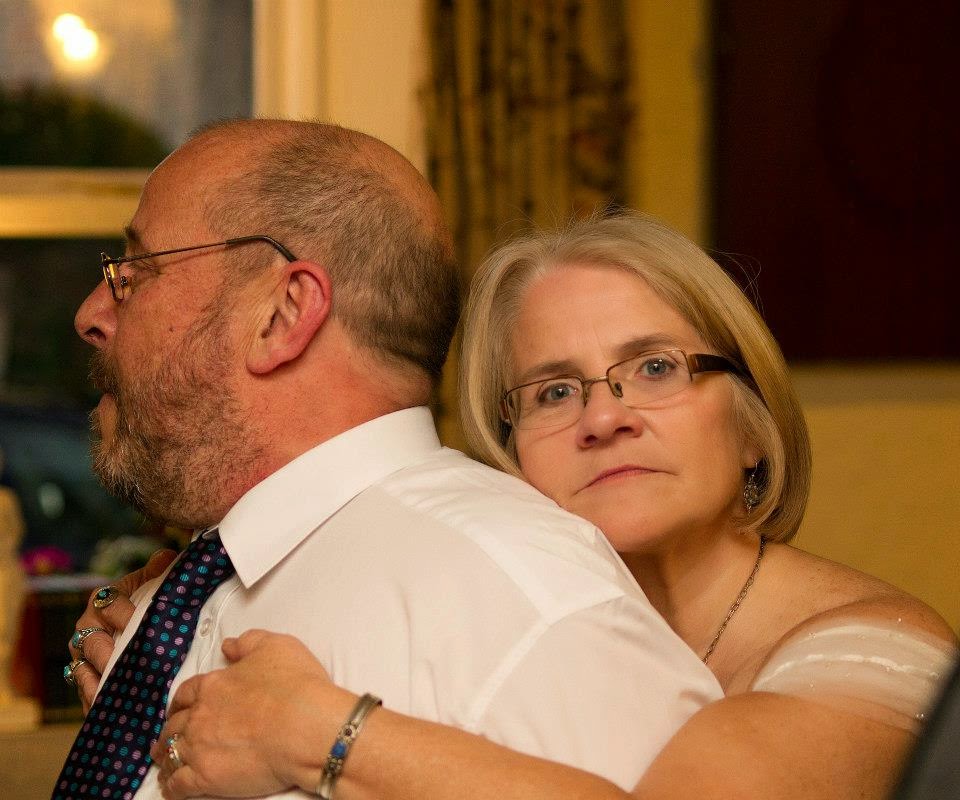
Stan's family at our wedding

In the two months of our new life together, we have sorted some things, adjusted to living in the same space, and deepened our love for and appreciation of one another. And I have found an easy rhythm to my life, awakening in the morning, listening to the silence, sometimes meditating, sometimes doing yoga, writing in my journal, hiking, when weather permits, in the hills just a few steps from our front door. It has been two months, and I am letting go of the craziness of society's merry-go-round. I am conserving my funds (I have just a little), trying to make it stretch, learning not to covet and buy at the drop of a hat, to resist the impulse to fill my days with material goods and desires. I am letting go of the destructive habits and distractions that fueled my participation in that crazy world, the world of striving and endless pursuit and relentless toil. I have applied for some jobs, but I am hoping to give myself, for the first time in my life, the time and space to write. To breathe. To be content to watch the wheels roll. 


Sunday, December 19, 2010

Christmas In the UK, 2010

Christmas Carol Singalong at the Royal Albert Hall
Happy Christmas from the UK, where it is a tradition to give out ‘crackers’-- cardboard tubes wrapped in festive paper that, when pulled, pop out a tissue crown, a useless toy, and a silly joke! Where the Christmas meal includes brussels sprouts, sausages, and this weird, flaming clump called Christmas pudding! Where everyone gathers around the telly on Christmas afternoon to listen to an address from the Queen! Where Boxing Day is celebrated with as much enthusiasm as the day that commemorates the saviour’s birth!

It is snowy here in England, one of an endless stream of wintry grey days that fold early into dark, black night. We string lights around windows and wear colourful scarves and cling to any spot of sun that brings a bit of brightness to our dreary winter season. We plan long weekends on warm beaches or desert resorts and wait in quiet acceptance for the promise of spring.

On days like this, I wonder if I did not lose my mind, almost two years ago, when I left family, friends and the comfort of a predictable job to move halfway around the world at the age of 52. On days like this, I am mindful of what I miss about life in the US, but also of the things I love about living on this quirky island in the North Sea.

What I Miss Most

Space: London houses roughly 12,500 people per square mile, a sliver of land bulging at the seams with humanity, leaving little room to move and breathe. In the mornings, we cram onto buses and trains, scurry down steps to the subway ‘tube’, bump into each other on skinny sidewalks, trudge home at night to tiny sitting areas too small to be termed ‘living rooms.’ No large, sweeping lanais, grand back yards, or walk-in closets here, at least not where I and most of the working class live.

I miss wide streets, miles of saw grass dotted with ponds and canals, patches of trees that line highways leading to long stretches of sugary, sandy beach.

Infrastructure: Duo-mat washers that crumple clothes into a wrinkled heap, ageing radiators that sizzle and boil but leave the room with pockets of frozen air, refrigerators the size of the dormitory fridges we had in college, plumbing pipes connected with duct tape to toilets that were not brought indoors until the 70s. The 1970s. Crumbling streets that cannot handle the bumper to bumper traffic, repairs that take weeks to schedule, and the laughable ineptitude of the Royal Mail.

Six weeks of holiday and working days that start at 9 a.m. and end promptly at 5 are great for employees, but an infuriating lack of service is one of the unfortunate consequences of a society that is not so work-driven. Queuing up, (or standing in line), is a daily activity, here, for 30 minutes to an hour, in the shops or on the telephone. Even the subways close down at midnight, leaving people who have attended late concerts ‘scrambling to make the tube.’ And an inch of snow brings the entire country to a grinding halt. Apparently those who manage the inner workings of this country have never heard of a shovel or a snow plow.

I miss the ease with which things flow in the United States—late night stores and restaurants, providers willing to accommodate working people, clothes you can pull from the dryer and wear without ironing, more than two cashiers in a busy grocery or clothing shop.

My friend said that England is called the “land of inconvenience.” It is a title that fits.

Family, Friends, and Familiarity: It is the country that birthed ours. It is a country with a shared language, shared history, and shared culture. But it is only now becoming a familiar place. They drive on the wrong side of the road, love baked potatoes with weird fillings stuffed in them, have an odd fondness for Heinz beans, and smoke like chimneys on the streets. They are a distant and formal people, who hide their detachment with polite speech and terms of endearment like ‘darlin’ and ‘love.’

I miss the known world of the country from which I came. I miss being able to pick up the phone and call best friends, and drive to see them when I am feeling alone. I miss the daily connection with my son, who is studying hard at University, whose life has blossomed in spite of his mother’s absence. I miss being able to visit cousins and aunts and uncles and siblings and nieces and nephews with a few hours’ drive or a short flight.

There is something to be said for living a life at ease, surrounded by people who know you best.

What I Love
No Guns: Crime exists, here, of course. People are robbed, burgled (I myself was robbed in February), sometimes stabbed. But the streets here do not carry the same feeling of paranoia and tension as American city streets. Mass shootings occur rarely and, when they do occur, are met with outrage and shock. Even the police do not have guns, a feature of their role that requires them to rule through collaboration rather than coercion.

Progressive, liberal, bleeding heart: There is a safety net for the poor here that, while insufficient, at least exists. People receive housing. Jobless receive a small allowance. Everyone is entitled to a basic level of care, including health care. Though the Tories are now in charge, and are making massive cuts, there are certain things they do not dare to question: the right of people to have a bed in which to sleep, a roof over their heads, and food to eat--the right of people to seek medical care without it crippling their future. Trade unions are celebrated and not a dirty word. People still protest in the streets. And the only tea baggers here are ones who pull them from their English tea!

Diverse: The other day I was walking down the street when an old Jamaican lady became tickled by the greeting honk of a bus driver speeding by. She spoke to me in a blend of Patois and English that I could not understand. But I delighted in her joy. Every day I share my work space with people from Zimbabwe, the Congo, India, South Africa, the Caribbean, Iran. I work with young men fleeing war and persecution in Eritrea and Afghanistan. I ride the bus home with women in saris and men in kufis and others in dreadlocks that reach the middle of their backs. I have learned about the Hindu festival of Diwali and the Muslim observance of Ramadan and their celebration of Eid. I have shared foods and juices prepared by foster carers who come from all over the world. Each day I learn something new about the people and cultures that surround me here, where we all manage to live together in community.

Culture and History: I have seen live theatre productions with Kevin Spacey and Jeff Goldblum and James Earl Jones. I have seen plays that I read and cherished as a child enacted on the greatest stages in the world. I have been to concerts at the Royal Albert Hall, and seen the original works of Vincent Van Gogh. I am surrounded by the spirits of the greatest writers that ever lived—Charles Dickens, James Joyce, Virginia Woolf. I have seen the great works of art at the Louvre. I stood at the site of a 6th century monastery in Ireland. I have experienced a world far beyond an Indiana girl’s wildest dreams.

Travel: My father once boasted that he had been to two foreign countries and all the states. His two foreign countries were Canada, and Hawaii before it was a state. My sister’s last wish was to visit a foreign country, a wish that she did not live to fulfill. I like to think that part of this travel is for them. I have been to the highlands of Scotland in search of the monster at Loch Ness. I walked the freezing streets of Paris with my son, and sat in "Le Deux Magots” that once fed Hemmingway and Oscar Wilde. I stood at Chopin’s and Jim Morrison’s Paris graves. I have been to Dublin and Wales and Denmark and walked the clean, symmetrical streets of Sweden. In January I go to Morocco and will catch a ride to Casablanca on the Marrakesh Express. In February I travel to Istanbul. I have other destinations planned, places I had thought beyond possibility not so long ago. Amsterdam in August. Italy in July. Prague in September. Vienna for Christmas next year.

I do not know how long I will be here. Immigration laws are becoming more severe. Events and circumstances may eventually call me home. If I have learned anything from the last few years, it is that it is foolish to believe in the sanctity of plans. Our lives can change in a moment, our futures turned upside down. Perhaps I was slightly mad when I decided to make this move. But I am so happy that I did.

Happy Christmas to all from across the pond~

~ Until we meet again.